Pages

About Me

My photo
I am from the Middle East and have lived a number of years in the US, France and the Middle East. After completing my engineering degree I randomly bounced around desk jobs in search for a steady career until, after 10 years, I've finally hit a brick wallI. Frustrated with the professional and social environment around me I decided to go off on a tangent: for a year I'll be on the road trekking all over Eastern/Central Europe and focusing on creative writing, the one thing I seem to find myself in.

I've been writing for a number of years. A few of my works have been published, but I've always been hesitant to call the craft of writing anything more than a hobby. During my journey across Eastern/Central Europe I'll be developing original ideas as well as writing about the places I visit. I'll be publishing my pieces on this blog while looking for other publishing opportunities where I go.

Please feel free to comment away and, if you like what you read, then please sign up to become a follower of my blog (gadget on the right, below the map)!

Thursday, 4 November 2010

Warsaw (Part III)

Milk bars are a relic of the communist times. These canteens first opened in the late 1940's to serve milk to the people, in an attempt by the communist government to popularize milk as a beverage. Some time later these milk bars became canteens that served cheap fast-food to the masses. Most of them closed when communism fell, but a small number still remain open. Probably thanks to loyal pensioners, students and bums - their main customers.  

The milk bar we went to in the district of Praga was sterile: dull blue walls, one small plant gracing the window overlooking the main street, grey linoleum floor and grey tables surrounded by plastic chairs. Elderly and middle-aged people with long faces and opaque gazes sat around their table slurping their soup or slowly chewing their food. They briefly glanced at us then quickly turned back to their food, as if the curiosity in our eyes brought about something painful in their minds. 


The system is simple: you order and pay for your food at one window, then wait until your order is called from another window. Our guide did the honours. He selected a few meals from a crumpled menu taped on the first window and placed the order to a stone faced old woman wearing glasses. She punched numbers on her massive till, presented the receipt to our guide and said out the price in a pre-programmed voice. Near us were people standing patiently in front of another window. A figure wearing an apron appeared on the other side, her face and legs hidden by the window's frame. A great balloon of steam rose from behind her. Her voice called out an order and a thick blue veined hand slid a plate on the counter to the other side of the window.

Our order was ready in a matter of minutes: seven plates of pierogi - dumplings stuffed with either meat, cheese, cabbage and some other vegetable. The group struggled to finish off the plain and oily food. Once done we had to return the plates back to the kitchen and dispose of the plastic cutlery in a trash that has seen better days. On my way out, as I walked past the pick up window, I heard something clumpy hit the ground. I turned to my left and saw a man in faded clothes holding a soup bowl filled to the brim that tipped in his hands. The soup was thick and brown in colour. It fell in chunks at the man's feet, making a dry and sick sound as each chunk hit the ground. Peas and other vegetables looked out of the thick brown liquid from the linoleum floor. The man just stared down at his feet, his hands still holding the bowl out in front of him, and let out a deflated sound, like a balloon losing its air.  

Wednesday, 3 November 2010

Warsaw (Part II)


I don't typically like to do tours - listening to someone recite history by rote is not a good investment of my time, especially considering I'll forget most of the information by the end. But in Warsaw I came across one I couldn't quite pass up. Adventure Warsaw takes you off the beaten path in a yellow coloured Socialist Nysa 522 (see picture) to the Communist highlights of the city. What's more, the tour guide/driver walks a fine line between being lively, funny and crazy. Our guide, for example, had many anecdotes and stories from history but kept on going on wild tangents that were often-times irrelevant yet nonetheless amusing.

The open-air market market in the district of Praga looked similar to an Arabic bazaar, except with Socialist overtones. The stalls were made of faded green wood rotting away at the seams and were manned by grey-faced old ladies and old men selling everything from wedding dresses to hair dryers and Gillette blades. No one shops in this market anymore. On the chance that we would stumbled on shoppers, they would be elderly. The women and men working at the stalls leave their post to chat with their neighbour, a cup of tea in their gloved hand. They would stop chatting and glance at us for a brief second before picking up their conversation again. They know we're not here to shop, that we're just here to take a look at thing of the past and to imagine how it used to be. But these are the last days of the open-market - there are plans in the works to remove the stalls and use the land to develop real-estate projects.     

At the other end of the market our tour guide pointed to a door behind him and, with a big smile on his face, said, "this is the best place. It's a sex shop and there's an old man working inside!" He walked up the few stairs to the door, opened it and stepped in. After a few seconds he waved us into the shop. There was an elderly man inside. He sat behind a desk stacked with old pornographic magazines and next to a shelf filled with sex toys. Behind the front door were various random items on sale such as old vacuum cleaners, used guitars, used sun glasses and more. The old man looked frail. He squinted at the light from the sun that reached inside his dark and mouldy shop. His head bobbed up and down as we walked in and he smiled, amused and slightly embarrassed. After everyone walked out our tour guide said a few words to the old man and closed the door behind him, forcing back the sunlight out of the shop.               


Tuesday, 2 November 2010

Warsaw (Part I)

"So, where about Australia you from?" Asked the Canadian, standing still and relaxed in his cashmere coat, his legs spread out in a wide stance.  

"Melbourne," Replied the Australian, digging his hands further into the pocket of his faded green jacket and his neck deeper into his scarf.  

"The wind - cuts right through you doesn't it?" The Canadian showed his teeth in a crooked smile, his eyes hidden behind black sun glasses.

"Yeah, it's awfully cold." Said the Australian between clenched teeth as a cold wind blew right through us. His tanned skin and short curly blonde hair stood out in Warsaw - it spoke of the golden sun and the deep blue sea. A world away from where we were.  

The three of us stood outside the red brick wall of an old Vodka factory in the district of Praga, waiting for the rest of our tour that went off to buy vodka in a small store attached to the inactive factory. Across the busy street in front of us were residential buildings of no particular character and cars parked everywhere. This district used to be the seedy part of Warsaw until artists moved in and slowly created a bohemian environment. 19th century buildings made from brick still stand here in contrast to downtown Warsaw, which has mostly been rebuilt after having been levelled to the ground by the Nazis during WWII. Destruction didn't reach across the Wisla river to Praga because the Russian army was stationed there, comfortable in it's front row seat to the theatre of Nazi carnage.              

"What brings you over to Warsaw?" Asked the Canadian.

"Thought I'd travel around before looking for a job," Replied the Australian.

"Back in Melbourne?"

"No, In London. Got no attachments in Melbourne."

"That's the way I like to live," replied the Canadian, nodding his head approvingly. His lips stretched again in a crooked smile: "no attachments in life," he punctuated this comment with his hand slowly slicing the cold air across his waist. "So where you heading after Warsaw?"

"Probably Slovakia, I guess. I'd like to eventually get to Turkey and maybe visit some of the countries in the Middle East. Don't know about the visa requirements for these countries, though. Guess I should check up on that."

"Nah, you'll be fine. You can pay for a visa when you get to the airport."

"How'd you know? Did you visit the Middle East?" Asked the Australian.

"Yeah, I went to a few countries there when I lived in Cairo," Answered the Canadian.

"Yeah? What did you do in Cairo?"

"Just hanging."

The Australian jerked his head back a bit back and furrowed his eyebrows. "Just hanging in Cairo?" 

"Yeah," shrugged the Canadian. "Everybody's got to hang somewhere," he added and flashed another crooked smile.

The door of the small vodka store swung open and two middle-aged English men walked out carrying plastic bags. Both calculated out loud how many quids they paid for their bottles, very satisfied with the bargain they got. A young girl walked out next, also carrying a plastic bag. She smiled at the Canadian and walked up to him. 

"So, what Vodka did you get for us?" He asked. 

"Check it out," She answered with a satisfied smile and opened the bag to show him.

Our tour guide walked out last from the store - the only one to come out empty handed. He only had on jeans, a white sweater and a scarf. Walking passed us, he flashed a wide smile and waved one skinny white arm for us to follow him. "Ok everyone, lets go to the open-air market. I know you must be hungry, but just hold on. Trust me, it's worth it. Afterwards we'll have lunch in a milk bar!"         


Wednesday, 27 October 2010

From Vilnius to Warsaw

Travellers have started to climb into the cars of the train that's sitting idly on the platform. The ride from Vilnius to Warsaw is nine hours long: three hours from Vilnius to Sestokai - the last stop before the Polish border - then a further six hours to Warshawna Centralna. The train looks old and decrepit: rectangular metal boxes on wheels, each box a dull colour and almost worn to the bone by age. Like all trains I've ridden on in Lithuania it stands high up from the platform. The steps to climb into a car are made of thick metal and are almost vertical to each other, like in a ladder. Sometimes I have to first swing my heavy backpack to the top before climbing the steps.

In the car I'm in there's a stream of people that have come from other cars, looking left and right at seats, and leaving at the other end. Seat-hunters scavenging for the best possible compromise between sharing and private space. On one side of the aisle are individual chairs facing each other while on the other side are benches facing each other. I choose a bench and set my gear down . Sitting opposite me was a heavy-set middle-aged man. His face was red and fatty, his hair short and curly grey. He had on a worn grey sweater with faded jeans. A light stuble covered his chin and cheeks. The man didn't seem to notice me. He stared vacantly outside the window, at the people on the platform.    

*

I'm feeling weary. The padding on the bench I'm sitting on is stiff. I've been travelling for less than a month and already it's getting to me, the stressful routine of unpacking, acclimating myself to the place I'm in, meeting people, leaving and starting all over again some place else. The balance between being a tourist and indulging in my creative world still escapes me. A lot of days feel wasted searching for it. 

The car softly rocks left and right as the train moves forwards at a casually speed. In the background, like a soothing lullaby, is the constant sound of wheels on train tracks and the creaking of joints. At the front of the car are three girls talking and laughing loudly. Coming from somewhere behind is music from someone's headphones - AC/DC's Highway to Hell. A railway employee forcefully opens the door to our car. Stiff on it's hinges, the door gives way against its will. The employee rushes forwards, his boots thumping down the aisle to the other end. 

There's no progress in the creative writing department: the few English language journals I've contacted in Lithuania have not responded and there seems to be very little interest in my blog. Maybe it's time I take it in a new direction and write for myself, to satisfy my creative and artistic inclinations.

"Biletai." A voice to my right. I turn and see a woman dressed professionally. A name tag hangs on her dark jacket and she holds somekind of object in her right hand. I hand her my ticket. She studies it briefly, stamps it with the object and hands the ticket back to me.

In the ticket office in Lithuania I met a Londoner also heading to Warsaw. A thin and tall fellow wearing a leather hat and leather jacket. He overheard me buying my ticket and started up a conversation with me. We chatted briefly - talked about our journey in this part of Europe - then split ways to buy food supplies for the train ride. I turned to look behind me, at the bench where he's sitting. His arms were crossed, his eyes closed and his leather hat sat on top his head. His body gently rocked in synch with the car. I faced forwards again. The middle-aged man in front of me removed a plastic 1.5 L bottle of beer from the bag between his legs, took long swigs from it, bottled it shut and replaced it back in his bag. 

The sky is a dull grey, the countryside outside is dark green and wild. The farm houses stare sadly at us, looking overwhelmed by their surroundings. Now and again factories appear - giant concrete buildings darker than the greyness of the day. Their windows are shattered and boarded up. Trash and rubble everywhere around them. These factories sit there abandoned, falling apart, their life very slowly seeping away into rust and dust.   

The train began to slow down in a screech of metal plates. I looked out the window, searching for the name of the station. Once the train stopped a voice said: "Kaunas." The grey haired middle-aged man looked at me. He didn't so much say the name of the station as cough it out of his system. He paused, turned his gaze to the people on the platform then mumbled: "Still one hour more." I gave a short nod. Minutes later the train jerked forwards, as if  hit from behind, and slowly started moving forwards. The man in front of me leaned his head back on the pad and closed his eyes.

*

In the small station of Sestokai all passengers heading to Warsaw stepped out of the train, walked to the other side of the platform and climbed up the cars of the train that pulled in a few minutes later. The Londoner and I shared an eight-seater cabin with an elderly couple from Canada and an American fellow wearing a New York Yankees baseball cap. Everyone greeted the other politely and said nothing more. The train jerked forwards and started moving. The couple softly talked amongst themselves in French, the Londoner crossed his arms over his stomach and the American fellow looked at each of us curiously, as if measuring the situation. I sat near the window and looked out at the tall trees passing by. A while later I noticed the train has still not picked up speed, then, on impulse, I voiced my thought: "I wonder if we've reached maximum speed..." Everybody laughed. The Londoner cracked a joke about the old train and the rest jumped in. 

After joking around we all introduced each other and talked about our respective journeys. Each of us started in the Baltics; the Londoner and the Canadian couple are ending their trip in Berlin; The American fellow has no final destination. A short and dark skinned middle-aged man, at first guess I would place him from the Asian subcontinent, but I never got to know for sure. He started talking about his trip and then went on about his previous trips. He's travelled all over the world and has had countless interesting experiences, which should make him very interesting if it wasn't for the fact that he doesn't know how to 'share' his experiences with others. He 'dumps' them on his listeners. Once he took the floor he owned the airspace. Every now and again I sensed an opportunity to change the course of his monologue. I'd jump in and share a story that would amuse everyone or that would get everyone in the cabin involved. But the fellow with the Yankees hat could not be denied, he always regained control of the conversation. This went on for hours on end until he finally went to sleep. Even then, the man snored as much as he talked when awake.

No one in the cabin ever got to know what the fellow with the Yankees hat does for a living to be able to travel so much - we all thought it was too improper to ask that question. Even the man's name is a mystery. The londoner heard it, but forgot it right away. Said it sounded unusual and that it begins with an 'F' or a 'V.' The last I saw of the mysterious man with the Yankees hat was him ploughing his way through the crowds of people in Warshawna Centralna to catch the next train to Krakow.

*

Warshawna Centralna is a maze of claustrophobic corridors lined with stalls on one side selling everything from DVDs to journals and tickets to public transportation. The walls of these corridors are grey, rotten and filled with bodies, the sounds of voices, trains and footsteps. The Londoner and I finally happened on stairs leading up to an exit. We ended up in the open air, by a busy overpass and motorway. Long yellow buses lined the side-walk. Inside were passengers sitting idly, covered up in winter clothing. Bright neon lights shone from somewhere. I turned around and saw, among other neon signs, the McDonald's golden arches and the word 'Saturn' in orange on the side of a massive modern building curving away from me. Across the motorway were tall modern block buildings. I was a bit overwhelmed - it's been over two weeks since I've been in a big city. The sound of cars from the other side of the overpass grew louder, like a wave gathering strength.        
                    

.           

Thursday, 14 October 2010

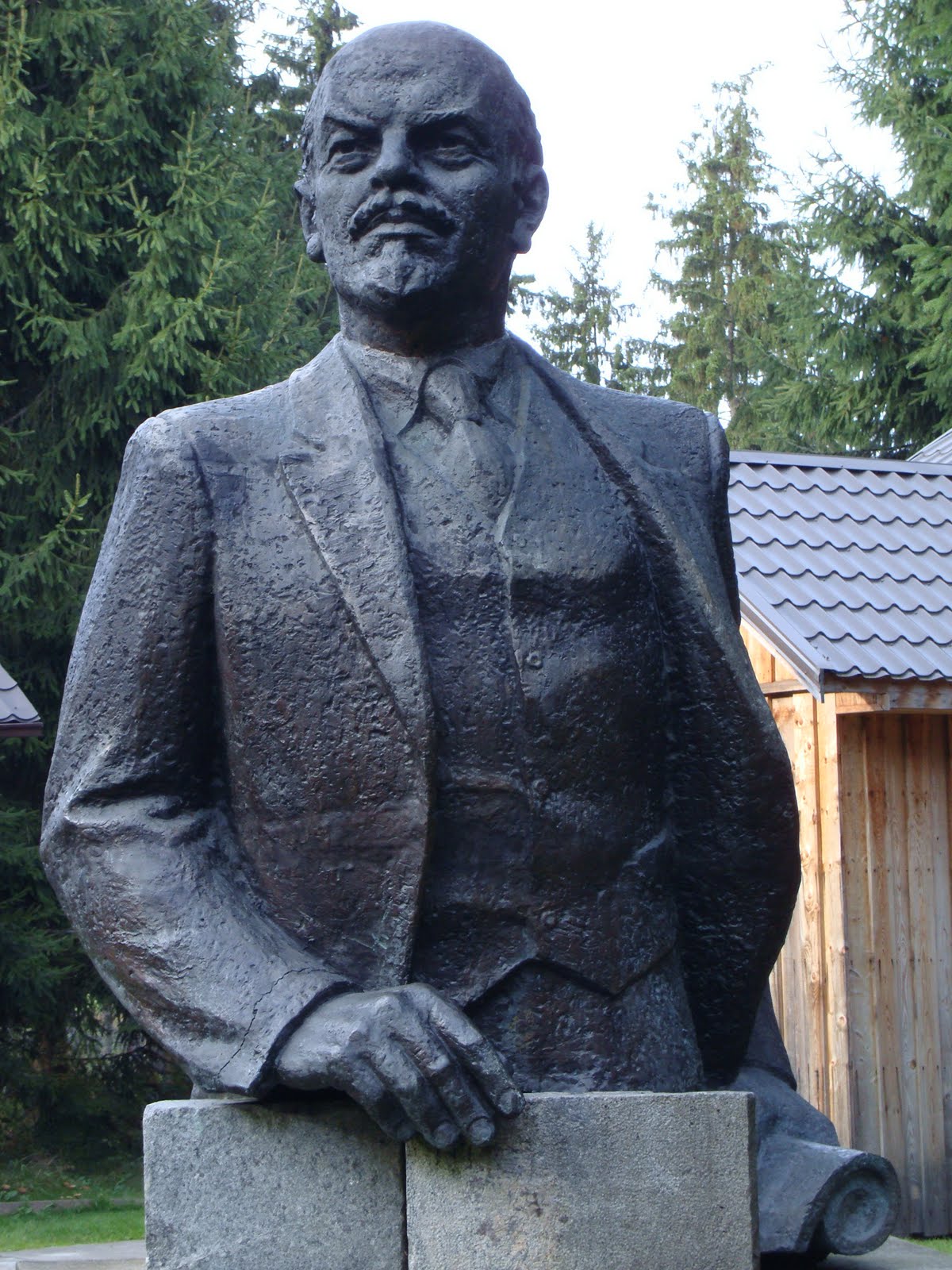
Grutas Parkas (Park of Totalitarianism)

Propaganda Statue
Soon after Lithuania regained its independence from the Soviet Union in 1990 the government started an initiative to erase any existing physical links to Soviet times. So any street named after Lenin, Stalin or any other notable Soviet figure had to be renamed. The same goes for statues of Soviet heroes: they were removed and tossed in storage to be forgotten. Eight year after independence still no one knew what to do with all these statues taking up space in storage. Wanting to know what ideas were out there, the government opened the floor for tenders. 

Important Soviet Figure
Many were sent. The winner was an eccentric millionaire by the name of Vilumas Malinauskas. His idea: create a park in the design of a gulag (watchtowers, barbed wire and wild nature) and stick those statues there. Visitors walk around in this open-air museum and admire Soviet-era statues. Genius? Madness? The idea, given the difficult times under Soviet occupation and the loss of lives fighting for independence, was so controversial that it bordered on madness. Yet Vilumas got the green light (probably because he financed the entire thing himself). The park opened in 2001 and was a runaway hit, becoming immensely popular with locals and foreigners. For his effort and vision, Vilumas Malinauskas even won the Ig Nobel Prize for Peace in 2001! This, mind you, is a parody of the Nobel Prize, for achievements that "first make people laugh, and then make them think."


Gulag Watchtower & Park Walkway
Lenin


Tuesday, 12 October 2010

The Baltic Chain

Vilnius Cathedral
At the end of one of the main thoroughfares in the old town of Vilnius is a cathedral sitting in the corner of a large square. The cathedral is of a gleaming white colour, its building imposing. On top of the main entrance are three statues of figures: two of them are in the background while the centre figure, Saint Helena, stands at the fore. One of her hands holds a large golden cross while the other hand hangs down to the ground, palm open as if inviting people to her. In the spacious square next to the cathedral people sit on the steps and relax, sometimes to study; young people ride their bikes or practice their skateboarding moves. At night I saw people there with telescopes looking up into the sky. 
Stebukla
Right below Saint Helena is a marble slab unlike the others. The slabs around the cathedral are mainly grey and bland, but this is one has Stebukla written in a circle with a star in the centre. People can be seen standing on the slab and turning around clockwise in a full circle, their eyes suddenly turning pensive for an instant then suddenly beaming. They just made a wish and hope that folklore will make it true. But that slab is also a marker of history: on it ended/begun one of the longest human chains formed in history. The date was August 23, 1989. Over one million people held hands for 15 minutes to protest against Soviet occupation. The chain spanned over 600 km and linked three different countries: Lithuania, Latvia and Estonia. Pictures reveal people of all ages, from the elderly to children. There is pride in their eyes and belief in their action. The Soviet empire may retaliate with brutality against this protest, brining about more pain and bloodshed, but the empire is already toppling. Independence is only a push away. 

A group of people finished taking their turn circling clockwise. I approached the slab after they walked away, looked down then in the distance, imagining the chain of people stretching away from me. I carefully stepped on the slab, closed my eyes and, in my mind, reached out in history to take a hand, to take my place in the chain  for freedom of the individual and against oppression from ideology.       


Monday, 11 October 2010

Cepelinai (Zeppelin)

On my last day in Vilnius I finally summoned the courage to try cepelinai - the Lithuanian national dish. If you're wondering why I waited so long, lets just say that I was looking after myself. Actually, I lied. I did try the local cuisine: potatoes topped with crackling. But (to put it in slang terminology) I haven't gone hard-core traditional. Instead, I mainly stuck to sandwiches and western cuisine. Going off on a tangent: pizza and pasta are incredibly popular in Lithuania. The local restaurant chain Cili Pica - the equivalent of Dominoes or Pizza Hut - has branches all over the country and cooks maybe the best pizzas I've ever had...        

So, Lithuanians, back in the day, were farmers. Their meals mainly revolved around bread, dairy products and sometimes meat (mainly pork meat). Cepelinai translates to zeppelin in English. The meal is a massive zeppelin shaped potato filled with some kind of stuffing and served with sauce. Needless to say: it's heavy. I skipped breakfast on that day, knowing that lunch was probably going to be my only meal. Since it takes about 20 minutes to prepare cepilinai I ordered a soup and 50 ml of Utenos dark beer - a cross between Guiness and Kilkenny. This was a big mistake. People with small stomachs, or who are not used to eating big meals, should never order a heavy beverage to wash down a filling meal.

The waiter brought my meal (see picture): two zeppelins filled with meat and covered in sour cream. I finished everything. It was tasty at first. But the experience slowly turned to pain after each bite and each sip of beer. In the end I could not get off my chair. I was comatose with one hand on my stomach, my mouth hanging open and my eyes turned inside my skull. the waiters and other clientèle must be used to this sight as they just let me be. In my mind there flashed the black and white images of the Hindenburg Zeppelin suspended in the air and consumed in flames. Once I regained a sliver of conciousness I settled the bill and managed to walk out of the restaurant. Dragging my feet on the cobbled stones, I made for the B&B - to my bed. But I only made it to my room before collapsing on the wooden floor. With my trembling hand I reached out to the warm blankets and comfortable mattress of my bed. But my strength left me, just like a balloon that got popped. And like that, the lights went off.